The Complete Guide to HTML5 Video Playback Speed
Every browser gives you a tiny speed menu – but a dedicated Video Speed Controller puts precise, real‑time adjustments directly at your fingertips. No uploads, no accounts, no tracking. Every speed change happens inside Chrome, on your device, and stays there.
- Why the built‑in Chrome speed menu is too rigid for students, researchers, and binge‑watchers
- How the Video Speed Controller extension replaces fixed presets with a fluid slider and instant reset
- Exactly what happens inside the browser when you move the slider – zero data leaves your computer
- How per‑tab isolation and Manifest V3 architecture protect your privacy without slowing Chrome down
Why Would You Need to Change HTML5 Video Playback Speed in Chrome?
The default playback speed controls in modern browsers are hidden behind a menu that offers only a handful of presets – 1.25×, 1.5×, 2×. For anyone who learns from online courses, reviews conference talks, or tries to absorb information quickly, those rigid steps can feel unbearably limiting. You might need 1.4× to match an instructor’s pace, or 2.3× to breeze through a slow tutorial – and neither option exists in the built‑in menu.
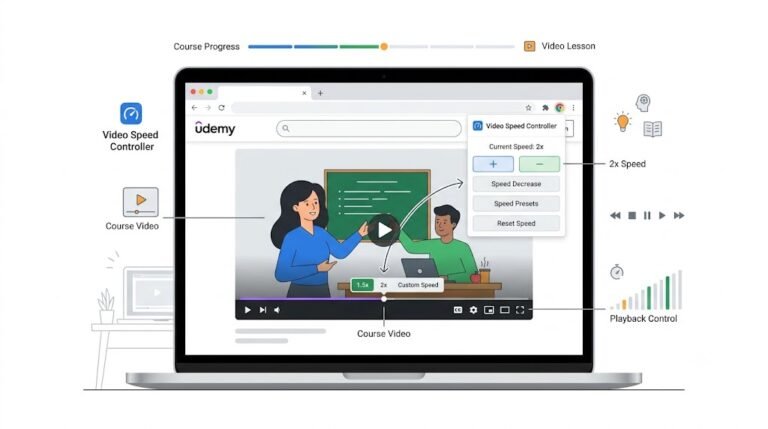
Video Speed Controller solves this by giving you a continuous slider that covers the entire usable range, from extreme slow‑motion to rapid scanning. Because it works with any standard HTML5 <video> element, you gain that control on YouTube, Vimeo, Udemy, university LMS platforms, and virtually every modern video site.
Even better, the extension never touches your video data. It simply tells the browser to present frames at a different rate. That means no buffering, no re‑encoding, and no privacy risk. The speed adjustment is 100% local.
What Is the Video Speed Controller Extension, and How Does It Work?
The extension is a lightweight Chrome tool that interacts directly with HTML5 video elements on the active tab. Its single job: read the video’s playbackRate property and set it to exactly the value you choose. There’s no magic, no servers, and no AI – just clean, privacy‑respecting code built on Chrome’s own APIs.
Here’s what happens step by step when you open the popup and move the slider:
- Active tab detection: The service worker checks the current tab and confirms that a playable
<video>exists. It uses theactiveTabpermission, granted only at that moment – no background scanning. - Real‑time speed assignment: The content script sets
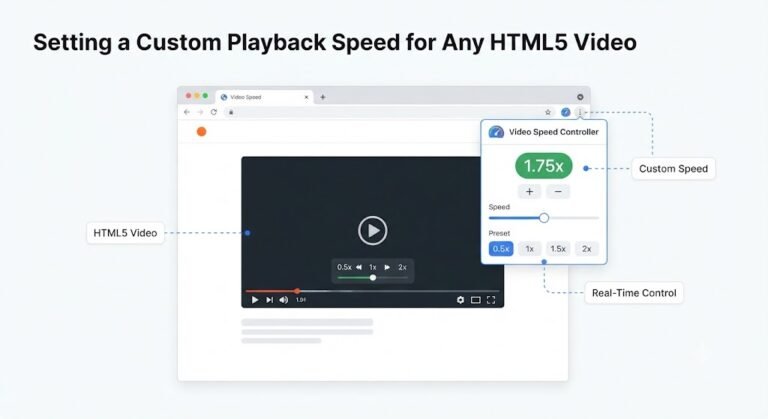
video.playbackRateto your chosen value (e.g., 1.75). The change takes effect instantly, even while the video is playing. - Feedback loop: The popup’s speed display updates live so you can see the exact multiplier. If you ever need to return to normal, the reset button immediately sets
playbackRate = 1.0.
All processing stays inside Chrome’s sandboxed extension environment. The extension follows Manifest V3 best practices: event‑driven service worker, minimal permissions, and no persistent background scripts that drain resources.
For a closer look at the extension’s privacy‑first design, visit the Video Speed Controller home page.
What Controls Does the Video Speed Controller Popup Give You?
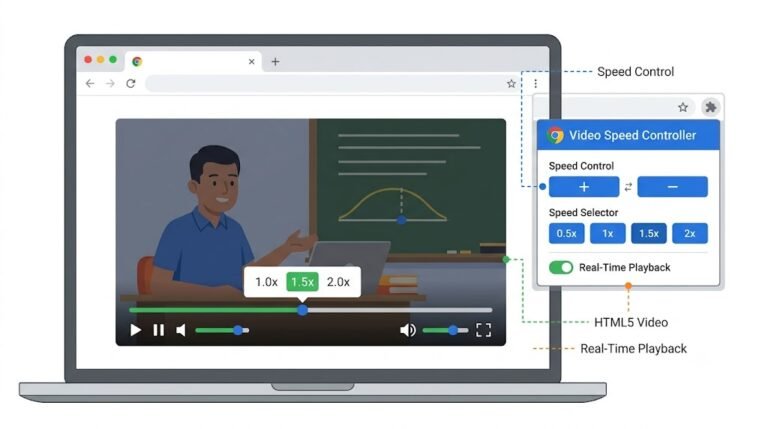
The popup is intentionally single‑purpose and distraction‑free. There are no nested menus, no settings pages to dig through – everything you need is visible the moment you click the toolbar icon.
- Speed slider: A large, responsive slider lets you drag the playback rate anywhere within a wide range. The current value updates live, so you can feel what 0.9× or 2.6× really means without guessing.
- Playback speed display: Next to the slider, the exact multiplier is shown in big, readable text. This removes any ambiguity and helps you build muscle memory for your preferred speeds.
- Reset button: One click returns the tab’s video to 1.0×. Essential when you jump from a slowed‑down lecture to a normal video call.
- Browser badge (optional): If enabled, a small number appears on the extension icon showing the current speed. It’s a quick at‑a‑glance reminder without opening the popup.
Because the popup only affects the active tab, you can have one video playing at 2× while another tab stays at 1×. That per‑tab isolation is what makes the extension a true productivity tool for multitasking learners.
How Does Chrome Handle Playback Speed Changes Under the Hood?
Understanding the internals helps you see why a local extension is safer than any online speed‑changing website. The extension never touches the video stream’s data; it merely tells Chrome’s media engine to present frames at a different tempo.
Key internal steps:
- Media element identification: The content script locates all
<video>nodes in the DOM. It does not scan page text or other elements – only what’s necessary to find active media players. playbackRateassignment: Settingvideo.playbackRate = 1.85tells the browser’s media pipeline to adjust the timing of frame presentation. The audio pitch stays natural because modern Chrome performs real‑time time‑stretching automatically.- Zero data transfer: No video bytes are captured, buffered, or sent anywhere. The extension never makes network requests – everything stays inside your device. You can confirm this by opening Chrome’s network tab while the extension is active; there are no outgoing connections.
- Compliance with Manifest V3: The extension runs as a service worker and uses only declarative permissions. It doesn’t persistently run in the background, which keeps Chrome’s memory footprint low and your battery healthy.
This architecture means you can speed through a sensitive corporate training video without worrying that your viewing speed is being logged, profiled, or leaked. Your playback choices are yours alone.
Does Changing Playback Speed Affect Video Quality or Audio?
A common worry is that speeding up or slowing down will cause blur, stuttering, or chipmunk voices. With a pure playbackRate adjustment – the method Video Speed Controller uses – the video frames and audio samples themselves remain completely unchanged. What changes is only the presentation rate.
- At moderate speeds (1.2× – 2.5×): Motion stays smooth because Chrome’s decoder drops frames intelligently only when necessary. The audio pitch is preserved automatically thanks to Chrome’s Web Audio time‑stretching engine.
- Extreme speeds (above 3×): Some visual jitter may appear on fast‑moving scenes, but this is a limitation of human perception and your monitor’s refresh rate – not a flaw in the extension or the video file.
- Slowing down (below 1.0×): Frames are displayed for longer, so motion appears slower but never blurry. Voices deepen slightly but remain perfectly intelligible.
Because the extension doesn’t transcode or filter anything, you never get the “ghosting” or colour banding that cheap video‑processing tools introduce. What you see is exactly what the platform delivers, just at your chosen speed.
Practical Examples: When Does Video Speed Controller Make the Biggest Difference?
Real‑world scenarios show how a fluid speed slider transforms the way you consume video content. Here are three situations where the extension saves time and reduces frustration.
Example 1: The Online Student Reviewing a Recorded Lecture
- Situation: A university lecture posted on Moodle runs at a slow pace. The student wants to review efficiently, but Chrome’s 1.5× jump feels too fast while 1.25× still wastes time.
- User action: With the lecture tab open, the student clicks the Video Speed Controller icon and drags the slider to 1.4×. Playback instantly adapts, and the spoken words remain clear.
- Extension processing: The content script sets
playbackRate = 1.4on the video element. No buffering, no re‑encoding – the browser’s decoder simply adjusts frame timing. - Result: The student finishes a 2‑hour lecture in under 90 minutes without missing any conceptual detail. When switching to a conference call tab, the reset button prevents a sudden speed‑up surprise.
Example 2: The Language Learner Dissecting Dialogue
- Situation: A learner watches a native‑language YouTube interview and needs to catch every word. Normal speed is too fast for parsing unfamiliar accents, but 0.75× feels unnaturally slow.
- User action: They open the popup, fine‑tune the slider to 0.85×, and listen while following subtitles. The live feedback lets them experiment until the rhythm feels comfortable.
- Result: The extension retains the audio’s natural pitch (thanks to Chrome’s time‑stretching), so the learner hears authentic pronunciation while having enough processing time. No listening data is ever collected.
Example 3: The Developer Scanning a Technical Tutorial
- Situation: A programmer watches a 40‑minute coding walkthrough. The explanations are helpful but the pace drags. They know the basics and just need to see the code portions.
- User action: In the Chrome tab with the tutorial, the developer sets the speed slider to 2.4×. During complex code snippets, they quickly reset to 1.0×, then slide back up.
- Result: The tutorial is skimmed in under 20 minutes. The extension’s lightweight design means zero lag even at high speed, and the laptop’s CPU stays cool because there’s no extra video processing – only a playback rate change.
Frequently Asked Questions
Will the extension work on every video website?
It works on any site that uses standard HTML5 <video> elements. That covers YouTube, Vimeo, Udemy, Coursera, most university LMS players, Google Drive previews, and many more. It cannot control videos served through Flash, Silverlight, or certain DRM‑encrypted streams that bypass the browser’s media stack.
Is my privacy safe when I change playback speed?
Absolutely. All speed changes happen locally inside your browser. The extension never sends video data, browsing history, or speed preferences to any server. It has no analytics, no tracking, and no advertising modules. You can verify this by checking Chrome’s network tab – there are zero external requests.
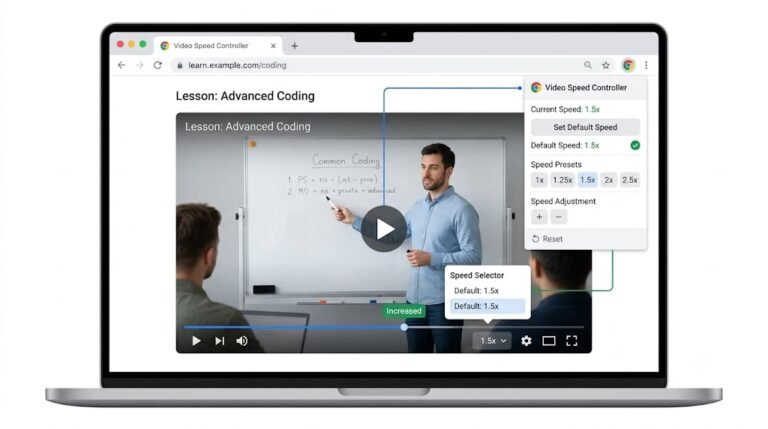
Can I set a default speed so all videos start at, say, 1.3×?
Yes. If you save your preferred speed through the extension, it stores that value in Chrome’s local storage on your device. Every time a new video loads in a tab, the extension applies your saved default automatically – no cloud, no login. The reset button always brings you back to true 1.0× when needed.
Does the extension drain battery or slow down my computer?
No. The extension’s CPU footprint is extremely low because it only runs a tiny content script to set the playbackRate property. It doesn’t perform any video processing, and the service worker is event‑driven (Manifest V3), so it sleeps when you’re not actively using the popup.
Why does the extension need the “activeTab” permission?
The activeTab permission is required to access the current page’s video elements when you click the extension icon. It does not grant permanent access to your tabs, and it never reads browsing history. This permission is used solely to detect and control HTML5 video playback speed.
Can I use keyboard shortcuts to change speed?
The current version relies on the popup slider for precise control. While there are no custom keyboard shortcuts built in, the popup is always just one click away. For a full feature list and updates, check the Video Speed Controller blog.
Take Control of Your HTML5 Video Playback Speed – Locally, Privately, and Instantly
A Video Speed Controller isn’t just a convenience; it’s a practical tool for anyone who regularly watches online videos for learning, research, or entertainment. By moving beyond Chrome’s limited preset menu, you gain the precision and speed that match your personal rhythm – without ever sacrificing privacy.
Key takeaways:
- Browser built‑in speed controls offer only a few presets; a dedicated extension gives you a continuous slider for exact adjustment.
- All processing happens on your device. No video is uploaded, recorded, or analysed.
- The popup’s slider, live speed readout, and reset button make playback adjustments fast and intuitive – even mid‑video.
- Per‑tab isolation and minimal permissions keep your browser fast and your data safe, in line with Manifest V3 standards.
Because the extension is lightweight, privacy‑first, and built on standard Chrome APIs, it fits seamlessly into any workflow. Open your next lecture, training video, or documentary, click the icon, and slide the speed up or down a few notches. When you’re done, hit Reset and carry on. For more insights into browser video control and privacy‑first productivity, explore the Video Speed Controller home page, learn how to change playback speed on any website, or discover the best way to slow down a video for detailed study.